
How to Choose a Reliable Fragrance Oil Wholesale Supplier in Australia
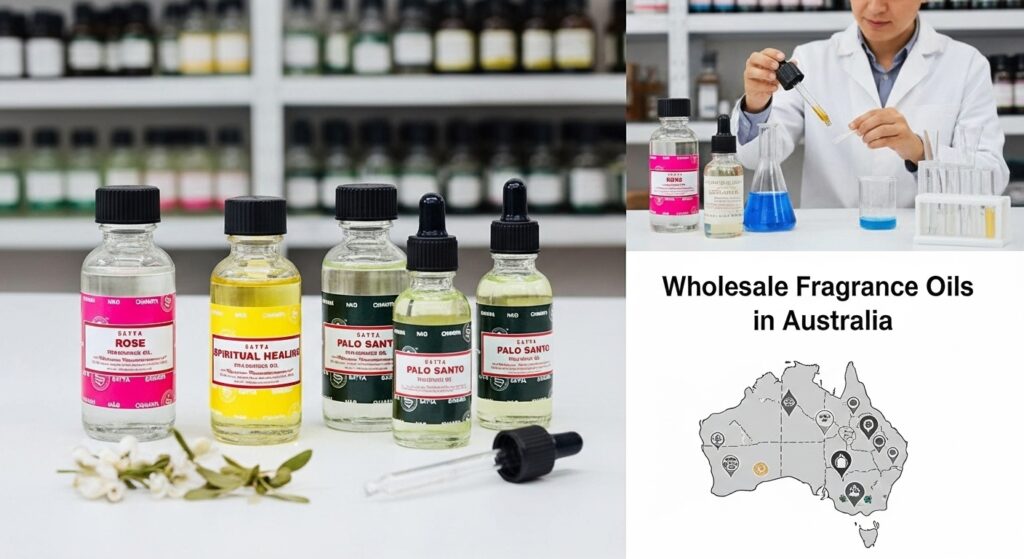
Your finished product should smell like your brand, not like a weak afterthought. But one bad batch of fragrance oils with no SDS and a freight delay can cost you time, money and customers.
If you sell candles, soaps or body care in WA, those risks are real, especially when suppliers are interstate.
This practical guide shows you how to buy fragrance oils in bulk the smart way. You’ll learn how to choose a reliable fragrance oil wholesaler in Australia, what to ask, how flashpoints affect candle pours, and why fragrance oils stock matters for faster delivery.
Read on for a local checklist and testing tips so you can order with confidence.
Understanding Fragrance Oil Wholesalers & Suppliers in Australia
Not all suppliers are the same. And knowing the difference will save you time, money and headaches when you buy fragrance oils in bulk. In Australia you’ll typically meet three types of partners:
- Manufacturers — they formulate and produce fragrances. Great for custom blends or large, branded runs.
- Distributors / Wholesalers — they stock lots of popular scents (including designer-style “perfume oil” duplicates) in convenient pack sizes. Ideal if you want variety without high MOQs.
- Local Perth warehouses / suppliers — Perth-based suppliers who hold stock in WA (for example, God Gift’s Malaga warehouse), a huge advantage for WA buyers because of quicker delivery and lower freight.
Many reputable Australian fragrance oil suppliers also offer value-add services: private-label bottling, technical support for candle/soap formulations, and critically, full SDS and allergen documentation so you can sell safely and legally.
5 Key Factors When Choosing a Fragrance Oil Supplier in Australia
Below are the five things every retailer, candle-maker or soap crafter should check:
1.Product Purpose & Suitability
Choose oils that are made for the product you sell. Candles, soaps or body care each need different formulations.
- Ask whether the fragrance is soap-safe, candle-safe or skin-safe, and request the recommended usage %. Typical ranges:
- soaps 3–5%
- lotions 1–2%
- candles 6–10%
- Confirm the oil’s known issues (some vanilla or gourmand scents darken soap; some notes cause ricing or separation). A trustworthy supplier will flag these up.
- Check pack sizes (500 mL, 1 L, 5 L, 20 L) so your order matches storage and cashflow needs.
2. Scent Notes & Fragrance Character
Understand the fragrance profile before you commit as notes determine how a scent behaves in different products.
- Read the top / middle / base note breakdown and visualise how it will work in your product (fresh/clean for soap, warm/spicy for candles).
- Test cold vs hot throw: always trial a small candle or reed diffuser — some oils smell great cold but lose key notes when heated.
- If you want premium or designer-inspired scents, pick a supplier that clearly labels “perfume-style” or “designer dupe” blends so you know what you’re buying.
3. Flashpoints & Thermal Stability
Flashpoint tells you the safe mixing temperature and whether a fragrance will survive your process.
- Ask for the flashpoint and never add fragrance above that temperature. If your wax pour temp exceeds the flashpoint, lighter top notes may evaporate or burn off.
- Check shipping/handling rules for low-flashpoint oils (some need special labelling or transport).
- Use the flashpoint as a safety margin: if a fragrance’s FP is 155°F (68°C), add it under that temperature in your process.
4. Safety Documents (SDS & IFRA Compliance)
Paperwork is not optional, it’s essential for legal compliance and customer safety.
- SDS (Safety Data Sheet): must be provided for every fragrance. It shows hazards, handling, storage and spill instructions. If a supplier can’t supply an SDS, treat that as a red flag.
- Allergen declaration: ask for a full list (e.g. linalool, limonene) and concentrations so you can label products correctly.
- IFRA / cosmetic guidance: if you’ll use fragrances on skin (lotions, perfumes), get IFRA limits or a certificate and follow recommended maximums.
5. MOQ, Pricing Tiers & Packaging Options
Make sure minimums, price breaks and containers match your business plan and storage.
- MOQ: confirm minimum order quantities for each pack size. Wholesalers allow smaller MOQs (500 mL–1 L), while manufacturers may expect larger bulk orders.
- Pricing tiers: ask for unit prices at different volumes (500 mL / 1 L / 5 L / 20 L) so you can model margins and reorder points.
- Packaging & private label: check container type (amber glass, pails, drums) and whether private-label or branded bottling is available. Private labelling usually has its own MOQ.
- Perth logistics: WA freight can add cost and time. Prefer suppliers with Perth stock or a local Malaga dispatch to reduce delays and freight surprises.
Questions to Ask a Fragrance Oil Wholesaler in Australia
- Do you provide SDS and IFRA/allergen declarations for this fragrance?
- Is this fragrance oil suitable for candle hot-throw at 6–10% usage (or for soaps/body at your desired %)?
- What is the fragrance’s flash point, VOC content and HAZCHEM code?
- What sample sizes do you offer, what are any fees, and how quickly can I get them shipped to Perth?
- What are your MOQ tiers and pricing bands (for 500mL / 1L / 5L)?
- Do you offer private labeling or custom blending? If so, what are your minimums and lead times for private-label bottles?
- Can you provide technical support or formulation advice (e.g. candle or soap testing) if issues arise?
- What are your payment terms and volume discount policies (e.g. for repeat large orders)?
Pro tip: When talking to each supplier, keep this checklist handy.
And for inspiration on choosing scents from top suppliers, see our blog on Top 15 Quality Fragrance Oils in Australia by God Gift. It highlights popular Australian scents and brands.
Fragrance Oils vs. Essential Oils: At a Glance
- Fragrance oils are lab-made scent blends (partly synthetic) designed for consistent, long-lasting aroma. They come in huge variety; including designer-style dupes. They are the go-to when you want reliable scent throw in candles, wax melts and commercial aircare. If you plan to buy fragrance oils in bulk, these give the best value and range.
- Essential oils are 100% plant extracts (steam-distilled or cold-pressed). Their aroma is truly botanical — lavender, citrus, eucalyptus — but the range is limited to what nature produces. Some are costly or seasonal, which affects availability and price.
When to choose which:
- Pick fragrance oils for strong, lasting scent in candles, soaps and diffusers or when you want designer dupes.
- Pick essential oils when a natural/therapeutic positioning matters.
Fragrance Oil Safety: Essential Dos & Don’ts
Understanding and following safe handling rules keeps your team, customers and products out of trouble. Always read the fragrance oil safety data sheet (SDS) and any IFRA guidance before you mix, ship or sell. Ask your fragrance oil wholesaler Australia for these documents if they’re not offered.
✔️ Dos — Safe practices | ❌ Don’ts — Hazards to avoid |
Dilute fragrance oils to supplier-recommended usage rates (start low and patch-test for skin products). | Don’t use fragrance oils neat on skin or ingest them. |
Wear PPE: gloves, goggles and an apron when handling concentrated oils. | Don’t expose oils to naked flames or heat above their flash point. |
Store in tightly sealed amber glass containers, in a cool, dark place with minimal headspace. | Don’t store long-term in plastic (it can leach) or reuse disposable containers. |
Keep the SDS and allergen/IFRA paperwork with your stock and make them available for staff. | Don’t buy or use a fragrance without an SDS; no SDS = red flag. |
Ventilate your workspace and use local exhaust when heating or mixing scents. | Don’t pour leftover oils down sinks, drains or into the environment. |
Label every container (contents, date, batch, hazard codes) and log stock movement. | Don’t mix oils or chemicals without checking compatibility on the SDS. |
Keep a basic spill kit and a suitable fire extinguisher nearby; clean spills promptly. | Don’t heat or pour wax/oils near the fragrance’s listed flash point. |
Use SDS/IFRA limits when formulating cosmetic products and record patch-test results. | Don’t use non-cosmetic-grade fragrance oils in lip or eye products. |
Ready to upgrade your scents?
Tired of weak scents, missing SDS or long WA delivery holding your business back?
Choose God Gift: Your Trusted Fragrance Oil Whole Supplier in Australia
We offer a wide range of fragrance oils for every maker and retailer: designer-inspired perfume dupes, natural essential-forward blends, candle-grade and soap-safe formulations, diffuser bases and perfume oils — all available in bulk sizes from sample bottles to 20 L drums.
Get a targeted sample pack shipped fast from our Malaga (Perth) warehouse. Perfect for local retailers, candle-makers and spas who want real assurance before committing to bulk orders.
Contact us today and try our designer-inspired and natural scents first — then buy with confidence.
Explore Our Fragrance Oil Online Now
FAQs
Q1: Are fragrance oils safe for skin, candles and diffusers?
Yes, fragrance oils are safe for skin, candles and diffusers when you follow supplier guidance. Use oils formulated for the application, follow SDS/IFRA limits, dilute and patch-test for skin, and use candle/diffuser-rated oils for burning or evaporation.
Q2: Do Australian suppliers provide SDS, IFRA/allergen info and test reports?
Reputable Australian fragrance oil suppliers must provide an SDS and allergen/IFRA information for each scent. Always request these documents before you buy.
Q3: What is a typical MOQ and sample policy?
It varies. Distributors mostly sell from 500mL–1L. Manufacturers may require much larger minimums. Most wholesalers offer paid or free sample packs. So, always ask about sample fees and Perth delivery times.
Q4: How long does shipping/lead time to Perth usually take?
If the supplier holds Perth/WA stock, delivery can be just a few days. For interstate or imported stock expect 7–14 business days; custom blends will take longer. Always request a written ETA.
Q5: Do fragrance oil wholesale suppliers offer private labelling or custom blends?
Many do. Private label and bespoke blends are common but come with higher MOQs and lead times. Ask for minimums, proofing steps and packaging options.
Q6: Are there discounts for recurring or large orders?
Yes. Most fragrance oil wholesalers in Australia offer tiered pricing or trade discounts for bulk or repeat purchases. Request a trade quote to secure better rates.